Articles · October 9, 2026
Ocala, St. Augustine, or Gainesville: choosing where to buy a horse farm in Florida
By Janie Coffey | Florida Equestrian Properties · 8 min read
The direct answer
Ocala, St. Augustine, and Gainesville support three genuinely different ways of living with horses in Florida. Ocala and Marion County offer the deepest equestrian infrastructure in the state, centered on the World Equestrian Center and a dense community of horse people. St. Augustine and St. Johns County offer quieter horse country near the coast, with historic farming communities and permitted beach riding. Gainesville and Alachua County offer rolling farmland with the University of Florida's Large Animal Hospital close by and the amenities of a university town.
Each market sits within a practical drive of the others, but they are not interchangeable. The right choice depends on how you use your horses, how much equestrian density you want, and how much you value the coast or a city. This guide compares the three across horse facilities, acreage, lifestyle, and access, and ends with a framework for deciding.
The three-way comparison
The table below summarizes the practical differences. Drive times and property character vary within each market, so treat it as a framework, not a guarantee. In every case, I measure the actual drive from each property to the services you rely on.
| Dimension | Ocala / Marion County | St. Augustine / St. Johns County | Gainesville / Alachua County |
|---|---|---|---|
| Equestrian infrastructure | The deepest in Florida: the World Equestrian Center, the Ocala Breeders' Sales Company, the Florida Horse Park, and hundreds of working farms | A quieter scene: the St. Johns County Equestrian Center in Hastings, public riding trails, and about 30 miles of permitted beach riding | Farmland with the UF Large Animal Hospital for advanced and 24/7 emergency equine care, plus the Alachua County Agriculture and Equestrian Center |
| Community | A dense, horse-first community with year-round competition | Historic farming communities with generational roots and a relaxed pace | A university town with rural surroundings |
| Proximity to the coast | Inland; about 1 hour 45 minutes to the St. Augustine coast | Close to the coast and the nation's oldest city | Inland; about 1 hour 35 to 40 minutes to the St. Augustine coast |
| Property character | Large working farms across protected corridors | Horse properties and estates in western farming communities such as Hastings and Elkton | Country estates and farmland communities such as Newberry, Alachua, and Micanopy |
| Market priority in my practice | Primary | Primary | Secondary |
| Best fit | Competitors, breeders, and buyers who want maximum equestrian density | Buyers who want horse country near the coast with room to breathe | Buyers who want a horse property with city amenities and a leading equine hospital close by |
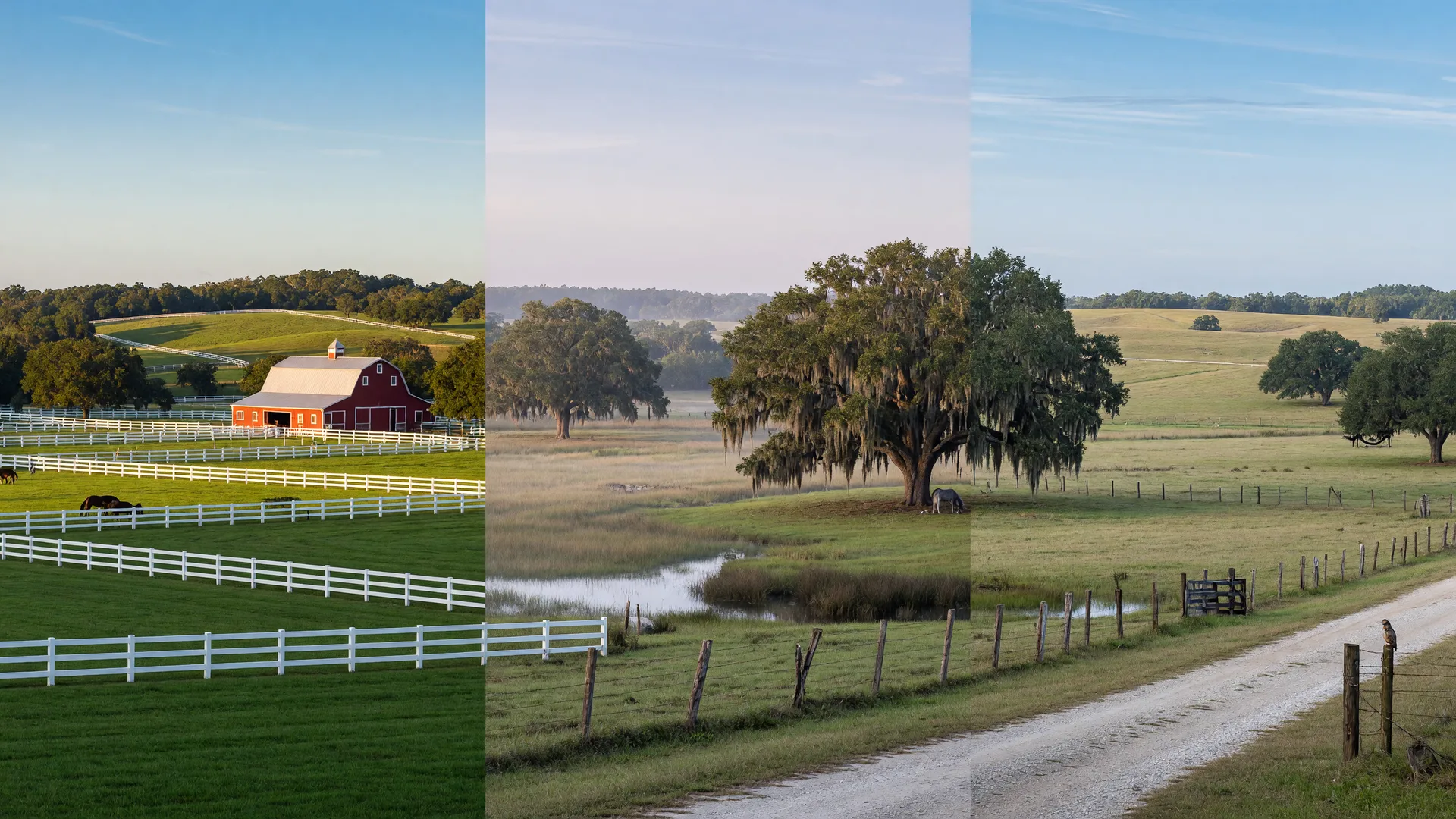
Ocala, St. Augustine, and Gainesville at a glance
Horse facilities and daily equine services
For serious competitors, Ocala has no equal in Florida. The World Equestrian Center at 1750 NW 80th Ave in northwest Ocala is the largest equestrian complex in the United States, with more than two dozen arenas and permanent stabling for roughly 1,500 horses. The Ocala Breeders' Sales Company is one of the world's leading auction houses for young horses, and the Florida Horse Park adds eventing, driving, and a large covered arena. Day to day, that means trainers, farriers, equine veterinarians, and tack shops are never far.
St. Johns County is a different scale, and that is part of its appeal. The county-run St. Johns County Equestrian Center at 8200 Smith Rd in Hastings offers arenas and stall boarding, and the county's riding trails include Princess Place Preserve and other public lands. St. Johns County also permits horseback riding on about 30 miles of its beach with a Special Use Beach Access Permit, subject to seasonal closures and county rules.
Gainesville anchors its horse community around the University of Florida Large Animal Hospital at 2147 Shealy Dr, the only equine hospital in Florida located within a college of veterinary medicine, offering advanced imaging, surgery, and 24/7 emergency care. The Alachua County Agriculture and Equestrian Center in Newberry hosts shows and events, and boarding and lesson barns are spread across the county.
- Ocala: World Equestrian Center, Ocala Breeders' Sales Company, Florida Horse Park, and a deep pool of trainers and services
- St. Augustine: St. Johns County Equestrian Center, public riding trails, and permitted beach riding
- Gainesville: UF Large Animal Hospital, the Alachua County Agriculture and Equestrian Center, and a network of boarding and lesson barns
Acreage and property character
Marion County holds more horses than any other county in the United States, roughly 75,000, and about 35 percent of Florida's horses. More than 1,200 horse farms sit across the county, most concentrated in the Farmland Preservation Area in the northwest, where county ordinance protects the agricultural character of the land. For buyers at the $1.5 million to $15 million level, that means a deep inventory of established working farms with barns, arenas, and fencing already in place.
St. Johns County offers a smaller but genuine inventory of horse properties and estates in the western farming communities of Hastings and Elkton. Properties tend toward the private and the pastoral: farms and estates where you keep your horses at home, ride in the neighborhood, and are a short drive from the beach and downtown St. Augustine.
Alachua County offers rolling farmland and country estates with communities such as Newberry, Alachua, and Micanopy nearby. The rural character is real, but the amenities of Gainesville and the University of Florida are close by, which appeals to buyers who want a horse property without giving up healthcare, schools, and culture.
- Ocala / Marion: the largest inventory of established horse farms in Florida, concentrated in protected corridors
- St. Augustine / St. Johns: private horse properties and estates in historic farming communities near the coast
- Gainesville / Alachua: country estates and farmland communities with city amenities close by
Lifestyle and access
Lifestyle is where the three markets separate most clearly. Ocala is a horse-first community: competition, sales, and the rhythm of farm life dominate, and the market is more competitive as a result. If you want to be surrounded by serious horse people, it is hard to match that density.
St. Augustine offers a different rhythm. Historic farming communities, a relaxed pace, and proximity to the coast and the nation's oldest city appeal to buyers who want room to breathe and a quieter daily life. You trade some equestrian density for that.
Gainesville sits between them in character and roughly in geography. It is a university town with rural surroundings, about 37 miles from Ocala and about 72 to 74 miles from St. Augustine. For a gentleman farm or a private horse property with city amenities close by, it can be an excellent fit.
How to choose
Start with your horses, then your daily life. List the equine services you actually use, then measure drive times from candidate properties, not from the county line. A farm on one side of a county can be much closer to a venue than a farm on the other side.
Ask how much equestrian density you want around you, how often you need training and competition, and how much you value the coast or a city. Then weigh the ownership tradeoffs: a more established working farm in Ocala, a private coastal property in St. Johns County, or a country estate with a leading equine hospital nearby in Alachua County.
I serve Ocala and St. Augustine as primary markets and Gainesville and Alachua County as an essential secondary market, and I help buyers compare across all three so they choose the community that fits rather than the first appealing listing.
Frequently asked questions
The questions below come up in most searches, and honest answers make the difference between a right fit and a costly mistake. If yours is not here, I would be glad to answer it directly.
How far apart are Ocala, St. Augustine, and Gainesville?
Ocala to St. Augustine is about 83 miles, roughly 1 hour 45 minutes to 2 hours. Ocala to Gainesville is about 37 miles, roughly 42 to 45 minutes on I-75. Gainesville to St. Augustine is about 72 to 74 miles, roughly 1 hour 35 to 40 minutes. That puts all three markets within reach of one another for buyers who want access to more than one.
Is Ocala or St. Augustine better for a luxury horse farm?
They serve different lifestyles. Ocala has the deepest inventory of established horse farms and the strongest equestrian infrastructure in Florida. St. Augustine offers horse country near the coast with a quieter pace. The right choice depends on how you keep and use your horses, and how much you value proximity to the coast.
Why would a buyer choose Gainesville over Ocala?
Gainesville offers rolling farmland with the amenities of a university town and the University of Florida Large Animal Hospital close by. Buyers who want a horse property with healthcare, schools, and culture nearby often prefer it, while buyers who want maximum equestrian density gravitate to Ocala.
Can I ride on the beach near St. Augustine?
Yes. St. Johns County permits horseback riding on about 30 miles of its beach with a Special Use Beach Access Permit, subject to seasonal closures and the county's rules. It is one of the distinctive advantages of the St. Augustine area.
Which market has the most equestrian infrastructure?
Ocala and Marion County by a wide margin, with the World Equestrian Center, the Ocala Breeders' Sales Company, the Florida Horse Park, and hundreds of working farms. St. Augustine and Gainesville both have genuine but smaller equestrian scenes with their own strengths.
Sources and further reading
- World Equestrian Center, Ocala facilities
- Ocala Breeders' Sales Company
- Florida Agriculture Center and Horse Park
- Ocala/Marion County, Florida Horse Country
- St. Johns County, Equestrian Center
- St. Johns County Horse Council, Resources
- St. Johns County, Special Use Beach Access Permits
- University of Florida Large Animal Hospital, About Us
- Alachua County Agriculture and Equestrian Center, Visit Gainesville
Related reading
About the author
Janie Coffey is a Northeast Florida real estate advisor with eXp Realty and a licensed general contractor. Based in St. Augustine, she helps buyers and sellers navigate equestrian properties, farms and acreage, and historic and waterfront homes.
- Zillow
- Realtor.com
- Instagram | @janiec
- Gorgeous Florida Homes Network | Janie's agent bio
- eXp Realty | Legacy & Land Advisory