Articles · November 3, 2026
Keeping horses at home: the daily responsibilities and property requirements
By Janie Coffey | Florida Equestrian Properties · 8 min read
Last updated November 3, 2026
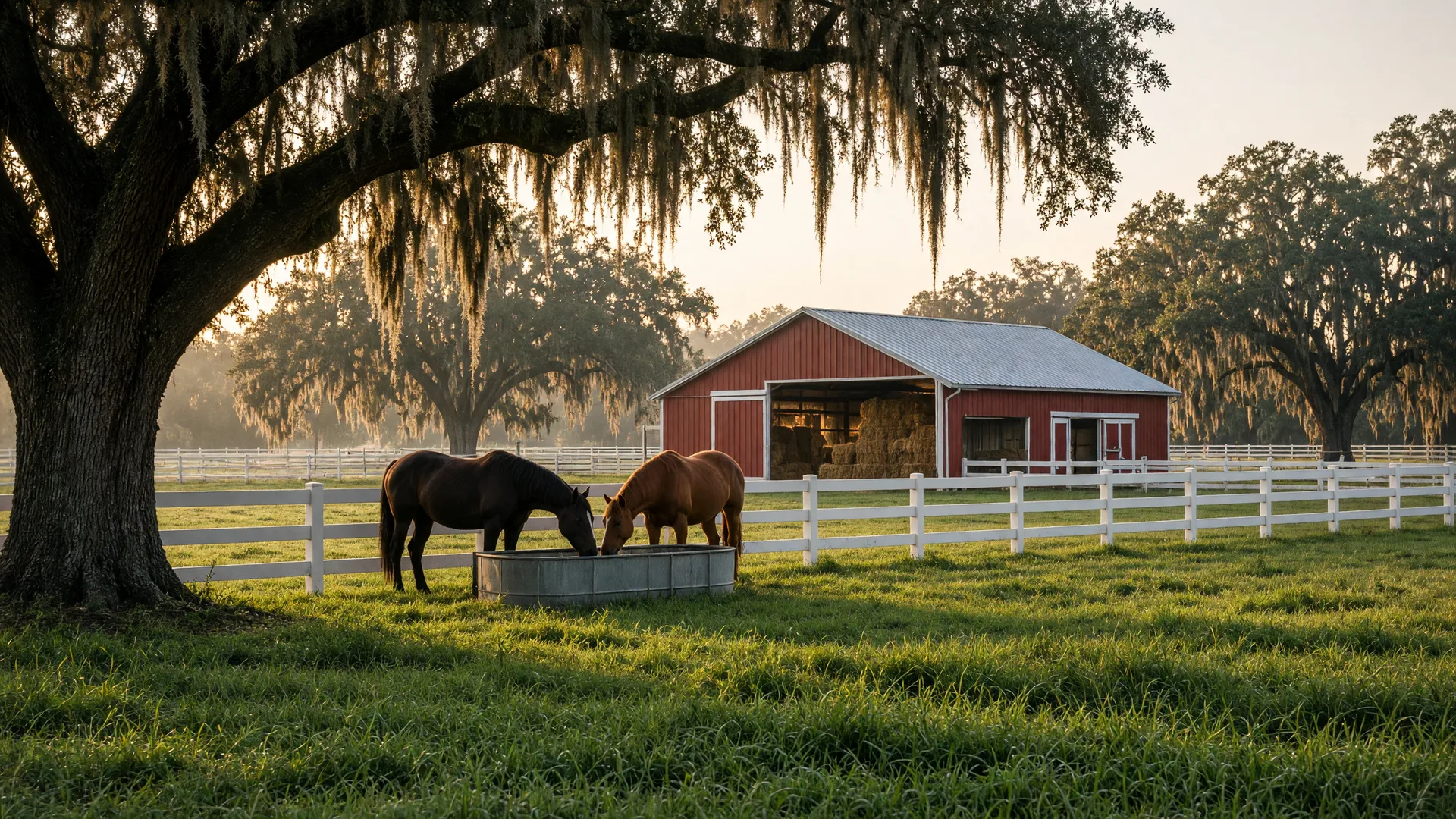
The direct answer: ownership is a daily commitment, and the property either supports it or fights it
Keeping horses at home means the daily work of horse care becomes yours: feeding and watering, turnout and exercise, stall cleaning, hoof and health checks, pasture rotation, and fly control, through every Florida season. The property you buy either supports that routine or fights it. A barn laid out for the work, water where you need it, paddocks that drain, and fence lines you can trust are what make ownership sustainable for years.
This article lays out the day to day, week to week, and annual rhythm of keeping horses at home, so you can measure any property against the work it will actually require. The figures come from University of Florida Institute of Food and Agricultural Sciences (UF/IFAS) and other university extension sources listed at the bottom of the page. Where I state a fact I link the source; where I offer guidance, it is my professional interpretation.
The daily routine: feed, water, turnout, and the check that catches problems early
Horses are grazers built to eat small amounts often. University extension guidance puts a mature horse's daily intake at roughly 1.5 to 2.5 percent of its body weight in forage, which means a 1,000-pound horse needs about 15 to 25 pounds of dry matter each day from pasture, hay, or a combination. Feeding is typically split into multiple meals, with clean water available at all times.
On water, a mature horse drinks roughly 10 to 12 gallons a day, and more when it is hot or working. In Florida's summer humidity that need climbs: UF/IFAS notes a horse can lose up to 15 liters of fluid an hour through sweat in hot, humid conditions. That makes water at the house, the barn, and the paddocks one of the most important daily-use features on any horse property, and it is a detail I check early in a search.
- Water at all times: plan for 10 to 12 gallons per horse per day, more in Florida heat, and check troughs daily
- Forage-based feeding split into meals, sized to the horse's body weight and workload
- Daily turnout for exercise and social time; in Florida summers, often from evening to dawn
- A daily health pass: eyes, legs, feet, appetite, manure, and any change in behavior
Stalls and manure: the workload no listing mentions
Stall care is the anchor of the daily routine for horses kept in at night. Extension guidance is to remove manure and wet bedding daily and to strip the stall completely, emptying all bedding and letting the surface dry, about once a week. How often a stall truly needs mucking depends on the horse, the bedding, and the season, but the daily habit is the starting point.
The manure itself is a number worth knowing before you commit: a 1,000-pound horse produces roughly 35 to 50 pounds of manure a day, about nine tons a year. That volume has to go somewhere, which is why daily removal matters twice over. It keeps stalls clean, and it is the foundation of fly control, since house and stable flies can develop from egg to adult in as little as seven days in summer.
- Muck stalls daily; strip and dry about once a week
- Plan for 35 to 50 pounds of manure per horse per day, and decide where it will go
- A compost system keeps the pile manageable and away from the barn and arena
- Fly control starts with sanitation: manure removal, dry stalls, and a covered compost pile
Hoof care, veterinary care, and the annual calendar
Hooves grow about three eighths of an inch a month on a mature horse, so farrier care is a permanent line item: generally a trim every 6 to 8 weeks, with shod horses often needing the same or closer intervals as shoes wear. In Florida specifically, wet footing promotes thrush and white line disease, so hoof care and turnout drainage go together.
The veterinary calendar follows a steady rhythm. Core vaccines recommended by the American Association of Equine Practitioners include tetanus, the encephalomyelitis viruses, rabies, and West Nile virus, and a yearly dental examination is recommended for every horse. Parasite control works best when it follows fecal egg count testing rather than a fixed rotation, because research shows a small share of horses shed most of the eggs. A current negative Coggins (EIA) test is standard for events, new facilities, and crossing state lines.
- Farrier trims every 6 to 8 weeks, more often for shod horses
- Core annual vaccines: tetanus, EEE/WEE/VEE, rabies, and West Nile virus
- Yearly dental examination and an oral-health plan with your veterinarian
- Fecal egg count based deworming rather than a fixed calendar
- Annual Coggins (EIA) test: negative within 12 months for shows and many facilities
Florida's summer: heat, humidity, and flies
Florida's summers change the schedule. Sweat evaporation is a horse's main cooling mechanism, and high humidity slows it, so extension guidance is to work horses in early morning or evening, cool them down thoroughly after rides, and offer shade and water through the day. Many Florida owners turn horses out from evening to dawn and keep the stalls available through the heat of the day.
Fly control in Florida is a season-long program, and the foundation is the same as stall care: remove manure and soiled bedding often, keep compost covered and turned, and keep stalls dry to reduce breeding sites. On top of sanitation, owners layer physical protection such as fly masks and sheets, traps and baits, and selective sprays. Fly masks and sheets also give sun protection, and pink skin on the muzzle needs sunscreen. Electrolytes should be offered the way extension veterinarians advise: products designed for horses, used with your veterinarian's input, and with plain water always available.
- Ride and work horses in early morning or evening, not the heat of the day
- Turn out overnight in summer and keep stalls available through the day
- Cool down thoroughly after work; cold-water hosing helps in the hottest months
- Sanitation first, then fly masks, sheets, traps, baits, and selective sprays
- Sun protection for pink skin on the muzzle and around the eyes
How the routine translates into property requirements
Read the daily routine backward and it becomes a property checklist. Water has to reach the house, barn, and paddocks with pressure to spare. Stalls and bedding space must fit your herd, with hay and feed storage sized to what you will carry. Paddocks around the barn need drainage that keeps the ground from turning to mud, and pasture needs room that matches your horse count. UF/IFAS puts a mature horse's pasture need at roughly 1 to 2.5 acres depending on site productivity and management.
Location matters too: a farrier and veterinarian you can actually reach, feed stores within a practical drive, and trailer access that lets you get in and out of the property. These are the quiet details that decide whether keeping horses at home feels like a reward or a grind, and they are the ones I walk with buyers long before an offer.
| Cadence | What the work looks like |
|---|---|
| Daily | Feed and water, turnout, muck stalls, and a health pass on each horse |
| Weekly | Strip stalls and dry, check fencing and gates, move and manage manure, rest or rotate pasture |
| Every 6 to 8 weeks | Farrier trim, more often for shod horses |
| Every 2 to 3 months | Fecal egg count testing and targeted deworming based on results |
| Yearly | Core vaccines, dental examination, Coggins (EIA) within 12 months, and a pasture soil test and plan |
| As needed | Fly program, barn and fence repairs, and drainage maintenance |
The maintenance calendar at a glance
Frequently asked questions
The questions below come up in most conversations with buyers weighing the move from boarding to keeping horses at home. If yours is not here, I would be glad to answer it directly.
How much time does keeping a horse at home take each day?
Feeding and watering, turnout, stall mucking, and a daily health check are the minimum, typically an hour or more per horse before chores, pasture work, and training are added. The honest number depends on the setup: how many stalls, how far the water and feed are from the barn, and how much pasture needs daily attention. That is why property layout matters as much as horse count.
Can one person manage a small private horse farm?
Yes, many small private farms and gentleman farms are run by one or two people, provided the stalls, water, fences, and pasture are sized to the workload. The design of the barn and paddocks determines how much time is spent walking and hauling; a property laid out for the work makes solo management practical, and one that spreads its facilities across the acreage makes it harder.
How much acreage do I need to keep horses at home?
UF/IFAS guidance is roughly 1 to 2.5 acres of pasture per mature horse, with the lower end on productive, well-managed pasture and the higher end on less productive sites, plus dry lot or paddock space around the barn. Smaller properties can work with careful management, confinement-style paddocks, and a solid footing plan, but the land has to be evaluated for what it can actually carry, which is where usable acreage, soil, and drainage come in.
Sources and further reading
- UF/IFAS Ask IFAS, Healthy Horses Handbook
- UF/IFAS, Hoof Care for Florida Horses (VM265)
- UF/IFAS, Protecting Florida Horses through Vaccination (VM248)
- UF/IFAS, Equine Dental Care (VM273)
- UF/IFAS, Developing a Deworming Program for Florida Horses (VM251)
- UF/IFAS, Manure Composting for Small Horse Farms (SS709)
- UF/IFAS, Pastures and Forage Crops for Horses (AA216)
- UF/IFAS, Managing Heat Stress in Horses (VM278)
- UF/IFAS Northwest District, Managing Horses to Prevent Heat Stress
- Penn State Extension, Filth Fly Control on Horse Farms
- University of Minnesota Extension, Fly control around horses
- University of Minnesota Extension, Ten things you should know about feeding the mature horse
- Rutgers NJAES, Horses and Manure
Related reading
About the author
Janie Coffey is a Northeast Florida real estate advisor with eXp Realty and a licensed general contractor. Based in St. Augustine, she helps buyers and sellers navigate equestrian properties, farms and acreage, and historic and waterfront homes.
- Zillow
- Realtor.com
- Instagram | @janiec
- Gorgeous Florida Homes Network | Janie's agent bio
- eXp Realty | Legacy & Land Advisory